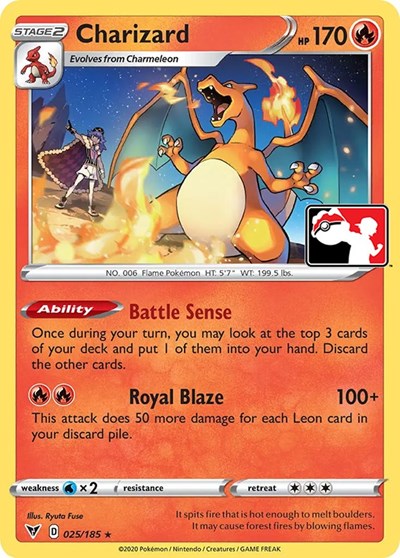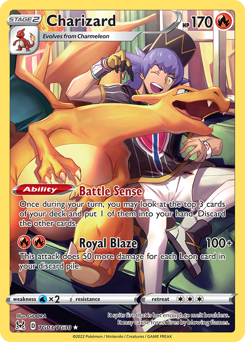
Charizard
 Skyridge · #146/144 · Rare Secret · 2003
Printings & price history
Loading chart…
Buy it now on eBay
Loading live listings…
Live from eBay · affiliate links support CardPrice · see recent sold results →
Graded values
Grades 1–6 are estimates modeled from the raw price — PSA/CGC/BGS 7–10 and Ungraded are live tracked market values.
PSA 10 chart is building — graded values are tracked nightly, a new point appears each day.
Graded population census · updated 2026-07-07
Population data from PriceCharting, updated monthly.
CardPrice Score A-TIER
Charizard's bottomless demand plus a scarce, notoriously tough-to-grade Crystal secret rare from a closed era makes this an easy A-tier chase.
- The crown jewel of Skyridge — a Crystal-type Charizard that closes out the e-Card era in style.
- "Rare Secret" status means it sits beyond the main set numbering, a true chase pull from the final English WOTC-era release.
- Crystal Charizard is one of the most iconic pull-a-holo-in-a-holo designs the classic era ever produced.
- Gem-mint copies are genuinely scarce; the surface and edges fight you hard at the top grade.
- Bridges two collector worlds: Charizard chasers and e-Card/Skyridge completists both want it.
This analysis covers every printing of Charizard — the score and live figures use our primary tracked printing, and the price panels above follow whichever printing you have selected.
Where Charizard fits in the hobby
Skyridge was the last set of the English e-Card era, the line of cards that carried dot-code strips readable by the Nintendo e-Reader. It closed out a strange, short-lived experiment in Pokémon's history — and it went out with one of the most beloved chase cards in the vintage catalog. Charizard 146 is the set's Crystal-type secret rare, numbered beyond the visible set count, exactly the kind of "one more than the checklist" pull that defines the era's most wanted cards.
Crystal Charizards are special because of the treatment: the artwork sits inside a shimmering crystalline holo frame that catches light differently across the whole card face, not just the picture window. It's a look that feels premium in hand in a way flat holos never do. Pair that presentation with the most bankable name in the hobby — Charizard — and you have a card that never really cools off.
Skyridge printing is also part of the legend. e-Card stock is notorious among graders for showing edge wear and surface flaws under scrutiny, which is a big reason clean high-grade copies punch well above their raw counterparts. This isn't a card you crack the top grade on by luck; the population reflects how tough the print run is on modern grading standards.
For a collector, Charizard 146 sits at a crossroads. It's a Charizard, so it draws the deepest demand pool in Pokémon. It's a Skyridge secret rare, so it anchors one of vintage's most respected set builds. And it's e-Card, a finite, closed chapter that will never see a reprint in this exact form.
Market read
This card lives in the upper tier of vintage Charizard demand without needing to be a first-edition base set relic. It's the modern collector's "classy" Charizard — recognized, respected, and genuinely scarce at the top of the grading scale. Trading is thin; copies don't change hands constantly, and when a strong grade surfaces it tends to draw focused attention rather than sit. That low-liquidity, high-conviction dynamic is typical of era-defining secret rares where supply is fixed and the buyer pool is patient.
The premium for a flawless copy over a raw or lower-graded one is steep, and that gap is the whole story here. Because the print stock punishes small imperfections, the jump from "nice raw card" to "top-grade slab" carries a serious multiplier. Expect any pristine example to command real conviction from buyers, and expect raw examples to trade on the gamble of what grade hides inside.
- Charizard — the single most demanded name in the hobby, full stop.
- Crystal-type treatment gives it a distinct, instantly recognizable premium look.
- Skyridge secret rare status makes it the marquee chase of a beloved set.
- e-Card era is closed and finite; no reprints in this exact form.
- Genuinely tough to grade high, so top-pop copies stay scarce and coveted.
Exact figures — price, population, gem rate, grading EV — are live in the panels above and refresh nightly.
Why the art matters
Kouki Saitou renders Charizard here in the Crystal-type frame that defines Skyridge's secret rares — the Pokémon set against a faceted, prismatic holo field that runs edge to edge rather than staying boxed in the art window. It's a presentation built to show off, all reflective geometry and shifting light. The dragon itself is posed with the confident, wings-flared energy collectors expect from a top-shelf Charizard card.
Saitou's work across this era leans into that crystalline aesthetic, and Charizard 146 is arguably the standout application of it. The design's whole appeal is how differently it reads in hand versus in a scan — the holo does things flat images can't capture.
Collector guide
e-Card stock is unforgiving. Check the edges first — Skyridge cards are known for chipping and whitening along the borders, and the dark frame shows it fast. Then examine the crystalline holo surface under angled light for print lines and scratches, which the reflective field readily reveals.
This is a strong grading candidate when the card is clean, precisely because the gap between a top grade and everything below it is so wide. But go in clear-eyed: the gem rate on this card is low, and centering plus edge wear are the usual points that cost a point. Only submit copies with genuinely sharp corners and clean borders.
Sleeve and toploader at minimum for raw copies; a sealed semi-rigid or a graded slab for anything you consider keeper-grade. Keep it out of direct light and away from humidity swings — the holo surface and dark borders are both vulnerable to long-term wear.
Verify the e-Reader dot-code strip along the card edge and confirm the Crystal-type frame and Skyridge set markings. English Skyridge Charizard 146 should carry Kouki Saitou's illustration credit and the secret-rare numbering beyond the main set count.
Amazon affiliate links — purchases support CardPrice at no extra cost.
Frequently asked questions
How much is Charizard #146/144 worth today?
As of August 14, 2026, a raw Charizard #146/144 trades around $3,250.00, and a PSA 10 copy around $82,532.81. Prices update nightly from live market data — the chart above has the full history.
Is Charizard worth grading right now?
Yes, the math currently works: after buying a raw copy and paying ~$25 in grading fees, the expected value of grading is about $32,885.15 positive, based on live PSA 10/9 prices and this card's real gem rate.
Why is Charizard 146 considered a secret rare?
Skyridge's secret rares are numbered beyond the set's visible checklist count, making them the hardest pulls in the set. Charizard 146 sits in that band as a Crystal-type card, which is the special holo treatment reserved for the era's chase Pokémon. That combination of extra rarity and premium design is what earns the "Rare Secret" tier.
What makes a Crystal-type Charizard different from a normal holo?
The Crystal treatment extends the holo across a faceted, prismatic frame rather than confining shine to the art window. It gives the whole card a reflective, gem-like surface that reads very differently in hand. It's a distinct look tied to the e-Card era and is a big part of why these cards carry a premium.
Why is this Charizard so hard to grade at the top level?
Skyridge used e-Card stock that's prone to edge whitening and surface imperfections, and the dark Crystal frame makes any flaw obvious. Centering is another common sticking point. As a result, gem-mint copies are genuinely scarce relative to how many exist in circulation.
How can I tell a genuine e-Card Skyridge Charizard?
Look for the e-Reader dot-code strip along the card's edge — a hallmark of the e-Card era. Confirm the Crystal-type frame, the Skyridge set symbol, and Kouki Saitou's artist credit. The secret-rare number 146 sitting past the main set count is another tell.
Is Skyridge Charizard part of the WOTC era?
Skyridge released in 2003 as the final English e-Card set, at the tail end of the Wizards of the Coast era of Pokémon TCG. It's often grouped with vintage WOTC-era chase cards for that reason. The e-Card mechanic makes it a distinct, closed chapter that was never reprinted in this form.
Should I grade a raw copy or buy one already slabbed?
That depends on your risk tolerance — this card's steep top-grade premium means a clean raw copy can be worth submitting, but the low gem rate means the gamble is real. If you want certainty, buying an already-graded copy removes the guesswork. Inspect edges and surface carefully either way.
Abilities
Attacks
How much is Charizard #146/144 worth?
A raw copy of Charizard #146/144 (Skyridge, 2003) is worth about $3,250.00 right now, based on the latest market data from August 14, 2026. Across the 2 printings we track, copies run anywhere from $2,999.99 to $3,500.00 depending on the version you're holding.
Grading changes the math on this one: a PSA 10 is valued around $82,532.81, roughly 25.4x the raw price, while a PSA 9 sits near $28,754.08. 1,554 copies have been graded to date, and 16% of them came back a 10 — worth knowing before you pay grading fees.
Prices on this page refresh nightly from live TCGplayer market data and are cross-checked against actual sold prices, so a single inflated listing never becomes "the price". The chart above has the full history.