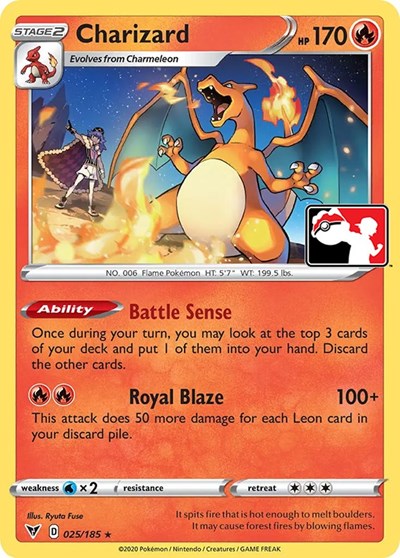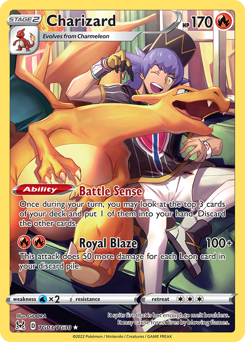
Charizard
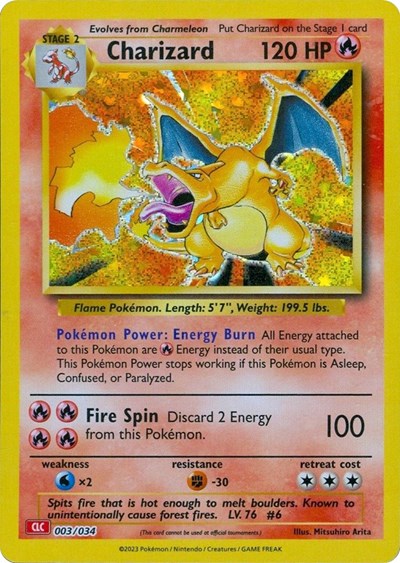
 Legendary Collection · #3/110 · Rare Holo · 2002
Printings & price history
Loading chart…
Buy it now on eBay
Loading live listings…
Live from eBay · affiliate links support CardPrice · see recent sold results →
Graded values
Grades 1–6 are estimates modeled from the raw price — PSA/CGC/BGS 7–10 and Ungraded are live tracked market values.
PSA 10 chart is building — graded values are tracked nightly, a new point appears each day.
Graded population census · updated 2026-08-01
Reverse HolofoilPopulation data from PriceCharting, updated monthly.
CardPrice Score S-TIER
The most iconic Charizard art in a finite farewell set, gated by a foil that makes gem copies brutally scarce — that's a textbook S-tier chase.
- Arita's original base-set Charizard art, reframed inside Legendary Collection's iconic foil border.
- A one-and-done set: 2002's nostalgia reissue that never got a sequel, so this print run is finite.
- That reverse-holo-style "cracked ice" foil is a nightmare to keep clean — high grades are genuinely scarce.
- One of the most chased non-1999 Charizards in English WOTC-era collecting.
- Gem-quality copies command a serious premium over raw, and the gap keeps widening.
This analysis covers every printing of Charizard — the score and live figures use our primary tracked printing, and the price panels above follow whichever printing you have selected.
Where Charizard fits in the hobby
Legendary Collection was Wizards of the Coast's farewell love letter — a 2002 set built entirely from reprinted cards spanning the earliest English Pokémon expansions. Charizard sat at the top of the wish list, carrying Mitsuhiro Arita's original base-set illustration into a brand-new frame. For collectors who missed 1999, this was the second chance at a holo Charizard, and it landed right as the first wave of Pokémon players were growing up and starting to look back.
What makes this card its own beast is the foil. Legendary Collection holos use the distinctive "cracked ice" pattern that shimmers across the entire card face — gorgeous under light, and brutal on grades. That full-surface foil shows every whisper of a scratch, every hint of a print line. Combined with the era's notoriously off-center cuts, clean copies were never common, and pristine ones are downright thin on the ground.
Because Legendary Collection was a single, self-contained set with no follow-up, the supply is what it is. There's no chase variant hiding in a later expansion, no reprint that dilutes it. It's simply the definitive early-2000s English Charizard, and it occupies that lane alone.
Market read
This is a blue-chip WOTC-era Charizard, and it trades like one. Raw copies already sit firmly in premium territory, and the jump to a gem-grade example is dramatic — the kind of multiple that tells you the market knows how hard this foil is to preserve. Population is healthy in the middle grades but thins fast at the top, which is exactly the shape collectors want in a chase card.
Sales volume runs quiet, which is normal for a card at this price point — holders don't flip these often, and each listing tends to draw real attention. The card sits close to its all-time high, signaling steady conviction rather than a speculative spike. For a collection, this is a cornerstone piece: recognizable, era-defining, and backed by the single most bankable name in the hobby.
- Charizard — the single most collected Pokémon, full stop.
- Arita's original base-set artwork carries multi-generational nostalgia.
- The cracked-ice foil makes true gem copies genuinely hard to find.
- WOTC-era pedigree: the last set before the license left Wizards.
- No reprint or sequel set to dilute the supply.
Exact figures — price, population, gem rate, grading EV — are live in the panels above and refresh nightly.
Why the art matters
Mitsuhiro Arita painted the Charizard that defined Pokémon for a generation — the coiled, roaring dragon from the 1999 base set — and Legendary Collection puts that same beloved illustration front and center. Arita is the artist most synonymous with Charizard, and this piece is his signature work: the creature mid-roar, wings flared, tail flame blazing against a warm sky.
Framed inside Legendary Collection's ornate gold-accented border and washed in the set's full-card cracked-ice foil, the familiar art takes on a new shimmer. It's the same Charizard collectors fell in love with, dressed up for a victory lap.
Collector guide
Inspect the full-surface foil under raking light — the cracked-ice pattern hides scratches and swirl marks that only appear at an angle. Edges and corners on WOTC-era cards chip easily, and the dark holo background makes any whitening obvious. Centering is the other big variable; front-to-back alignment on this era ran loose.
This is a strong candidate for grading — the premium on top-grade copies is substantial and the surface is the main gatekeeper, so a clean example rewards the effort. Because so much rides on foil condition and centering, only submit copies you've vetted carefully under good light. Middle grades are far more plentiful than gems, which is what drives the spread.
Sleeve in a penny sleeve plus a semi-rigid or top loader immediately; the full-card foil scratches from card-on-card contact. Store upright, away from heat and direct light to protect the holo, and keep humidity stable. For graded copies, a hard case and UV-limited display preserve that shimmer long-term.
Confirm the Legendary Collection set symbol and the card number to distinguish it from the 1999 base-set Charizard, which shares the same Arita art. Genuine copies show the distinctive uniform cracked-ice holo across the entire card face — reproductions often get the foil texture or the border detailing wrong. Check the back and font sharpness against a known-authentic reference.
Amazon affiliate links — purchases support CardPrice at no extra cost.
Frequently asked questions
How much is Charizard #3/110 worth today?
As of August 14, 2026, a raw Charizard #3/110 trades around $400.00, and a PSA 10 copy around $121,550.00. Prices update nightly from live market data — the chart above has the full history.
Is Charizard worth grading right now?
Yes, the math currently works: after buying a raw copy and paying ~$25 in grading fees, the expected value of grading is about $16,146.18 positive, based on live PSA 10/9 prices and this card's real gem rate.
Is the Legendary Collection Charizard the same as the 1999 base set Charizard?
They share Mitsuhiro Arita's exact artwork, but they're different cards from different sets. Legendary Collection is a 2002 reprint with its own set symbol, card number, and a full-card cracked-ice foil pattern instead of the base set's window holo. Check the set symbol and the holo style to tell them apart at a glance.
Why is this Charizard so hard to find in high grades?
The cracked-ice foil covers the entire card face, so it shows scratches, swirls, and print lines far more readily than a standard holo window. Add in the era's loose centering and chip-prone edges, and pristine copies become genuinely scarce. That difficulty is exactly why top grades carry such a large premium.
What makes Legendary Collection special?
It was Wizards of the Coast's final Pokémon set — a 2002 collection built entirely from reprinted early-era cards. There was no sequel, so the print run is self-contained. That closing-chapter status gives it a distinct place in English WOTC-era collecting.
Is this card worth grading?
For clean copies, generally yes — the gap between raw and gem-grade examples is significant, and surface quality is the main thing graders scrutinize. The catch is that the foil hides flaws, so vet any copy carefully under angled light before submitting. Middle-grade copies are common, so the value really lives at the top.
Who illustrated this Charizard?
Mitsuhiro Arita, the artist behind the original 1999 base-set Charizard and the illustrator most associated with the character across Pokémon's history. Legendary Collection reuses his iconic illustration. It's widely considered the definitive Charizard art.
Abilities
Attacks
“Spits fire that is hot enough to melt boulders. Known to unintentionally cause forest fires.”
How much is Charizard #3/110 worth?
Right now (August 14, 2026) the going rate for an ungraded Charizard #3/110 from Legendary Collection is about $400.00. Across the 3 printings we track, copies run anywhere from $459.14 to $6,999.00 depending on the version you're holding.
Grading changes the math on this one: a PSA 10 is valued around $121,550.00, roughly 303.9x the raw price, while a PSA 9 sits near $15,564.10. 4,033 copies have been graded to date, and 2% of them came back a 10 — worth knowing before you pay grading fees.
Prices on this page refresh nightly from live TCGplayer market data and are cross-checked against actual sold prices, so a single inflated listing never becomes "the price". The chart above has the full history.