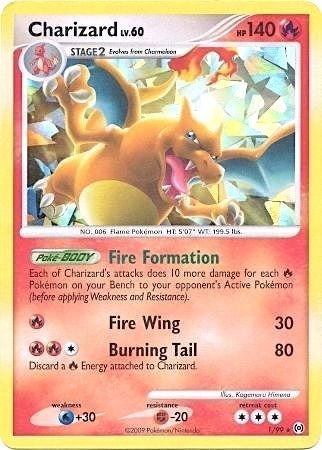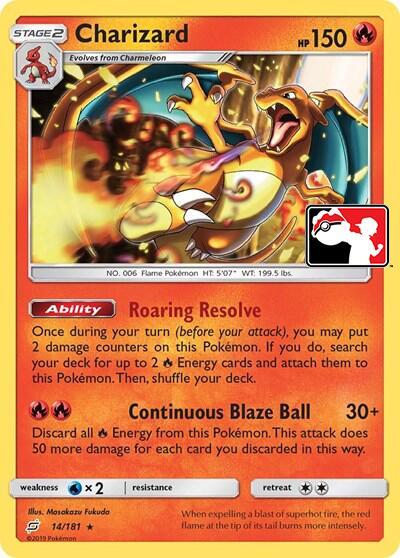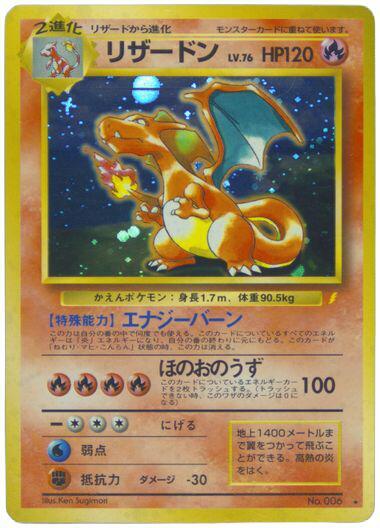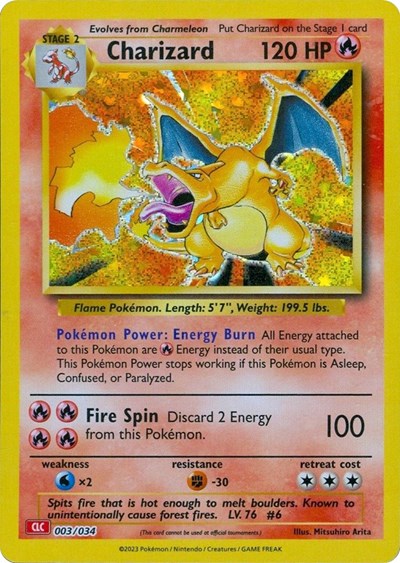
Charizard
 Base · #4/102 · Rare Holo · 1999
Printings & price history
Loading chart…
Buy it now on eBay
Loading live listings…
Live from eBay · affiliate links support CardPrice · see recent sold results →
Graded values
Grades 1–6 are estimates modeled from the raw price — PSA/CGC/BGS 7–10 and Ungraded are live tracked market values.
PSA 10 chart is building — graded values are tracked nightly, a new point appears each day.
Graded population census · updated 2026-08-01
ShadowlessPopulation data from PriceCharting, updated monthly.
CardPrice Score S-TIER
It's the definitive grail of the hobby — unmatched icon status, bottomless demand, and a punishing gem rate that keeps top copies scarce.
- The single most iconic card in the hobby — the card that made Pokémon a collectible.
- Mitsuhiro Arita's Base Set Charizard is the grail that everyone from casual fans to serious investors chases.
- Rare Holo from the 1999 English Base Set, the foundation of Western Pokémon collecting.
- Gem Mint copies are brutally scarce — the print run is huge, but pristine survivors are not.
- An S-tier chase card that anchors nearly every high-end vintage collection.
This analysis covers every printing of Charizard — the score and live figures use our primary tracked printing, and the price panels above follow whichever printing you have selected.
Where Charizard fits in the hobby
There is no card more central to the hobby than Base Set Charizard. When the English Base Set landed in 1999, this was *the* card kids ripped packs chasing — the holo everyone wanted, the one that got sleeved, traded, and sometimes ruined in the process. Its fire-breathing Arita artwork became the face of the entire franchise's trading card game, and decades later it still holds that crown.
As a Stage 2 Fire type, Charizard sat at the top of the Base Set food chain, and its scarcity relative to the other holos (it was short-printed compared to the rest of the set's rare holos) only amplified the mystique. Every collector who came up in the late '90s remembers wanting this card. That emotional pull is exactly why it commands the attention it does today — it's nostalgia, status, and hobby history compressed into one piece of cardboard.
The card exists in several distinguishable variants — the 1st Edition (the true grail), Shadowless, and the more common Unlimited print. Each occupies its own tier of demand, but even the most plentiful Unlimited version carries enormous cultural weight. When mainstream media covers Pokémon cards, it's almost always a Charizard on screen.
For collectors, this is the anchor card. Owning any clean copy is a rite of passage; owning a high-grade one is a genuine trophy.
Market read
Base Set Charizard is the bluest of blue-chip Pokémon cards — the benchmark against which the entire vintage market is measured. Its population is enormous because it's the most-submitted card in the hobby's history, yet demand runs so broad and so deep that supply rarely feels loose. Casual buyers, lifelong fans, and high-end collectors all compete for the same cards, which keeps liquidity high across every grade tier.
Like the broader vintage market, it has cooled meaningfully off its peak frenzy, and it sits well below its all-time high. That's context, not a red flag — this remains one of the most tradeable cards on the planet with steady sales volume. The gem rate is punishing given the era's centering and print issues, so pristine copies stand apart from the sea of mid-grade examples. The premium for a top-grade specimen over a raw copy is real but comparatively modest here versus rarer chase cards, simply because so many high-grade copies exist relative to almost any other vintage grail.
- Unmatched cultural iconography — the definitive face of the Pokémon TCG.
- Deep nostalgia from the original 1999 English release generation, now adult collectors with buying power.
- Constant mainstream and media visibility keeps new buyers entering the market.
- Multiple collectible variants (1st Edition, Shadowless, Unlimited) create tiered demand across budgets.
- Brutally low gem rate makes high-grade copies scarce despite the massive population.
Exact figures — price, population, gem rate, grading EV — are live in the panels above and refresh nightly.
Why the art matters
Mitsuhiro Arita painted this Charizard, and it's arguably the most famous illustration in the entire franchise. The card depicts Charizard mid-roar, wings spread and flame-tipped tail blazing, rendered in Arita's textured, painterly style that defined the look of the original Base Set. It radiates power — exactly the impression a Stage 2 fire dragon at the top of the set should give.
Arita has become a legend among collectors largely because of this piece, and he has revisited Charizard many times over his career. But this original Base Set rendering is the one that started it all, and it remains the definitive image most people picture when they think "Pokémon card."
Collector guide
Base Set holos are notorious for edge whitening on the dark blue borders, holo scratches on the foil window, and print lines. Check the corners and back edges under good light — even sealed-away copies often show handling wear from the era. The holofoil surface scuffs easily, so surface flaws are the most common grade-killer.
With a very low gem rate driven by chronic centering and surface issues, this is a card where careful pre-screening matters. High-grade population is large in absolute terms, so the premium for a top grade over a clean raw copy is more modest than on rarer grails — factor that against grading costs before submitting a mid-grade candidate.
Sleeve and hard-case at minimum; a penny sleeve plus a rigid holder protects the fragile holo surface and dark borders. For any premium copy, a sealed slab or a UV-protected display case guards against light and humidity. Keep it away from temperature swings that can warp vintage stock.
Know your variant — 1st Edition stamp, Shadowless (no drop shadow behind the art box, thinner HP font), and Unlimited all look similar at a glance. Counterfeits of this card are among the most common in the hobby; verify holo pattern, font weight, texture, and back coloring, and lean on reputable grading for anything at the higher end.
Amazon affiliate links — purchases support CardPrice at no extra cost.
Frequently asked questions
How much is Charizard #4/102 worth today?
As of August 14, 2026, a raw Charizard #4/102 trades around $2,146.38, and a PSA 10 copy around $28,207.60. Prices update nightly from live market data — the chart above has the full history.
Is Charizard worth grading right now?
The numbers currently say no: after grading fees, expected value is about $6,683.28 negative unless your copy is an exceptional gem candidate. Grade for the slab, not for profit.
What's the difference between 1st Edition, Shadowless, and Unlimited Base Set Charizard?
1st Edition carries a stamped "Edition 1" logo on the left and is the scarcest and most valuable. Shadowless lacks the drop shadow along the right side of the artwork box and has slightly different fonts and coloring, sitting between 1st Edition and Unlimited in demand. Unlimited is the standard print with a drop shadow and is by far the most common.
Why is Base Set Charizard so valuable if so many were printed?
Demand is the answer, not scarcity of the print itself. It's the most iconic Pokémon card ever made, so buyers across every collecting segment compete for it. High-grade copies are genuinely scarce thanks to a low gem rate, which concentrates value at the top of the condition scale.
Why do so few copies grade Gem Mint?
Base Set stock is prone to centering problems, and the holofoil surface scratches and shows print lines easily. The dark borders also reveal the slightest edge whitening. Combined, these era-specific issues make a flawless copy far rarer than the huge overall population suggests.
Is Base Set Charizard a good entry point into vintage collecting?
For many collectors it's the ultimate goal rather than the starting point, but a clean mid-grade Unlimited copy is one of the most liquid and recognizable cards you can own. It anchors a vintage collection and is almost always in demand. Just be sure to authenticate carefully given how heavily it's counterfeited.
Did Mitsuhiro Arita illustrate other Charizard cards?
Yes — Arita has painted numerous Charizard cards across the franchise's history and remains closely associated with the character. But this Base Set illustration is his most famous and the one that defined the card's legendary status.
Abilities
Attacks
“Spits fire that is hot enough to melt boulders. Known to unintentionally cause forest fires.”
How much is Charizard #4/102 worth?
Right now (August 14, 2026) the going rate for an ungraded Charizard #4/102 from Base is about $825.38. Across the 4 printings we track, copies run anywhere from $450.00 to $100,000.00 depending on the version you're holding.
Grading changes the math on this one: a PSA 10 is valued around $28,207.60, roughly 34.2x the raw price, while a PSA 9 sits near $3,185.71. 99,246 copies have been graded to date, and 0% of them came back a 10 — worth knowing before you pay grading fees.
Prices on this page refresh nightly from live TCGplayer market data and are cross-checked against actual sold prices, so a single inflated listing never becomes "the price". The chart above has the full history.